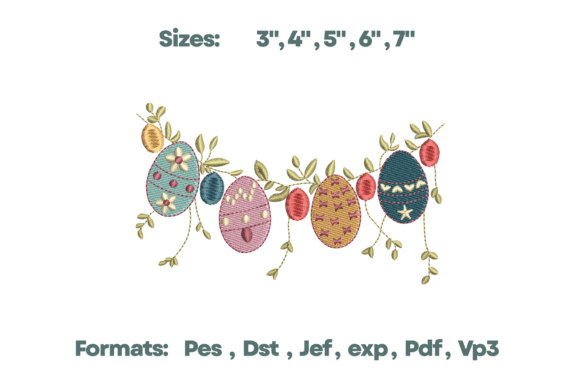
Boho Easter Egg Garland Embroidery
A Designer’s Real-World Review Before the First Stitch
As an embroidery designer who’s shipped over 3,000 custom pieces—from boutique aprons to Etsy baby blankets—I approach seasonal designs with equal parts excitement and scrutiny. When I saw Boho Easter Egg Garland Embroidery on Creative Fabrica, my first thought wasn’t “cute”—it was “Can this hold up on a textured linen tote? Will those floral eggs read clearly at 3 inches wide on a curved cap? Is the stitch density forgiving for cotton blends?” That’s the lens I used while evaluating it—not as a holiday decoration, but as a working machine embroidery design for real clients and repeatable handmade products.
First Impression: Mood Over Motif
The Boho Easter Egg Garland Embroidery lands with quiet confidence. It’s not loud or cartoonish—it’s layered, organic, and intentionally unstructured. The eggs aren’t symmetrical; they tilt, overlap, and nestle into trailing vines and tiny blossoms. That asymmetry is its strength: it reads as hand-drawn, not algorithmic. As a designer, I appreciate how the balance of satin stitch egg outlines, delicate running stitch stems, and airy fill stitch petals creates visual rhythm without heaviness. This isn’t just an Easter motif—it’s a bohemian design asset that works year-round on nursery pillows, kitchen towels, or even minimalist sweatshirt cuffs.
Fits Naturally Into These Real Projects
- Tote bags & aprons: The sprawling layout flows beautifully across wide, stable surfaces—especially when centered or anchored near a side seam. No awkward cropping needed.
- Baby blankets & pillow covers: Soft edges and botanical detail lend warmth without overwhelming delicate fabrics. Works well in tone-on-tone thread for subtle luxury.
- Kitchen towels & tea towels: The garland shape mirrors classic towel hems—ideal for top-border placement. Avoids dense centers that trap moisture.
- Embroidered patches: Easily cropped into smaller segments (e.g., one egg + vine) for iron-on or sew-on patches. Holds detail well at 2.5–3" width.
- Custom apparel: Performs cleanly on mid-weight cotton and cotton-blend sweatshirts—just avoid ultra-stretchy knits unless stabilized heavily.
Where to Pause—and Test
This isn’t a “load-and-go” design. Its elegance comes with nuance. Here’s what I watched closely during test runs:
- Hoop size matters: The full garland spans generously. If you’re stitching on caps or small accessories, plan to crop or use only a 2–3 egg segment. Check the file dimensions before hooping.
- Stitch density varies: Floral centers and egg interiors have higher density than stems—great for texture, but requires appropriate stabilizer (cutaway for knits, tear-away for stable wovens).
- Small details demand attention: Petals and vine tendrils are fine but legible. On dark fabric, I switched to matte pastel threads—not high-sheen—to preserve softness. Always run a test on scrap first.
- Curved surfaces need adjustment: On baseball caps, I reduced top tension slightly and used a low-profile cap hoop. The garland’s gentle curve adapted better than rigid geometric patterns.
- Wash durability: After three cold-machine washes on a linen-cotton kitchen towel, stitches remained crisp—no fraying or puckering—when proper stabilizer and quality thread were used.
How It Elevates Your Handmade Product
Using Boho Easter Egg Garland Embroidery does more than add decoration—it deepens perceived value. Customers notice the intentionality: the way flowers echo the egg shapes, how spacing invites the eye to wander slowly, how the whole piece feels *designed*, not assembled. That translates directly to:
- Stronger product photography: Natural light catches satin stitch highlights and layered fills—no extra editing needed.
- Higher trust in handmade presentation: Buyers associate thoughtful detailing with care in construction and materials.
- Consistent brand voice: Perfect for makers whose aesthetic leans earthy, slow-made, or artisanal—not mass-produced holiday kitsch.
- Better giftability: Feels personal and curated, especially when paired with neutral textiles (cream linen, oatmeal terry, charcoal denim).
- Etsy & craft fair appeal: Stands out in search results for “boho embroidery,” “botanical Easter,” and “handmade kitchen decor”—not just “Easter eggs.”
Practical Notes Before You Stitch
Before adding Boho Easter Egg Garland Embroidery to your next order or digital inventory:
- Download and open the digital embroidery file to confirm format compatibility with your machine (check Creative Fabrica’s file list—don’t assume).
- Review the license terms on the product page—especially if selling finished items commercially or as part of a subscription box.
- Test on your exact fabric type and color. A light-thread-on-dark test reveals clarity issues faster than any screen preview.
- Compare mockups on light vs. dark backgrounds—some floral details recede on black unless thread contrast is intentional.
- Use a printable mockup to visualize scale on your intended product (e.g., “How much of a sweatshirt front does this cover?”).
- Inspect stitched samples under natural light—not just studio bulbs—to assess texture, sheen, and shadow play.
Final Thought: A Thoughtful Addition, Not Just a Seasonal Fill-In
Boho Easter Egg Garland Embroidery succeeds because it respects both the craft and the customer. It doesn’t shout “Easter!”—it whispers “carefully made.” That subtlety makes it unusually versatile: equally at home on a spring baby onesie, a summer farmers’ market tote, or a fall-apron launch. For designers building a library of reliable, mood-forward design assets, this isn’t just another holiday download. It’s a quietly confident embroidery file that earns its place in repeat orders, curated collections, and handmade shops where authenticity matters more than trend-chasing. Just remember—like any strong design—it rewards preparation, testing, and attention to context. Stitch it right, and it won’t just decorate your product. It’ll deepen its story.