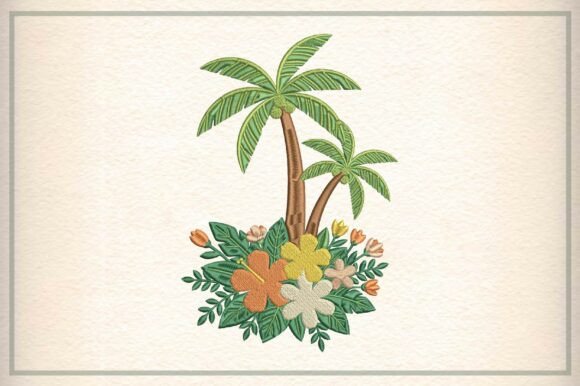
Tropical Palm and Flower Embroidery
First Impressions: A Breath of Warm Air, Not Just Another Summer Cliché
When I opened the Tropical Palm and Flower Embroidery file, I didn’t see “beachy” or “trendy”—I saw intention. The composition leans gently to one side, with a tall, slightly curved palm frond anchoring the top while blossoms—hibiscus? plumeria?—spill outward in soft asymmetry. It’s not overly dense, but it’s not sparse either. There’s breathing room between leaves and petals, which tells me this machine embroidery design was digitized with stitch flow in mind—not just visual appeal. That matters. A lot. Because what looks lush on screen can turn muddy under thread if the fill stitch paths don’t respect fabric movement.
Real Project Test: That Tote Bag You’ve Been Meaning to Launch
Last week, I stitched the Tropical Palm and Flower Embroidery onto a natural canvas tote for a small-batch boutique launch. Not as a test swatch—but as the hero element on a 9” x 10” front panel. The result? Immediate warmth without looking costumed. Customers paused. They touched the stitching. One asked, “Is that hand-embroidered?” (It wasn’t—but the satin stitch on the flower centers and subtle variegation in the leaf veins gave it that handmade weight.) This isn’t background filler. It’s a statement that says *carefully made*, not mass-produced. For Etsy sellers and craft business owners, that distinction converts browsers into buyers.
Where It Shines—and Where It Asks for Your Attention
This embroidery file thrives on stable, medium-weight fabrics: cotton twill aprons, brushed poly sweatshirt fleece, linen tea towels, and structured pillow covers. On those surfaces, the design reads clearly at 4–5 inches wide—the sweet spot for tote bags, baby onesies, and kitchen linens. It also holds up beautifully as an embroidered patch when backed with tear-away stabilizer and finished with a clean merrowed edge.
But—and this is where experience kicks in—don’t rush it onto thin jersey tees or stretchy baby knits without testing. The leaf stems use fine running stitch detail that can distort if the fabric shifts mid-hooping. And on dark fabric? Check your thread colors early. The original palette assumes light-to-medium backgrounds; switching to charcoal or navy means rethinking contrast in the flower centers and vein highlights. Also, avoid placing it over seams or curved areas like cap crowns unless you’ve confirmed hoop clearance and adjusted tension manually.
Stitch Density & Stabilizer Strategy
The Tropical Palm and Flower Embroidery uses moderate stitch density—no swampy fill zones, no fragile single-thread outlines. That’s smart. It means less puckering on woven cotton and better drape on apparel. But “moderate” doesn’t mean “low effort.” I still used medium-weight cutaway stabilizer for the tote bag (to prevent backside shadowing) and switched to lightweight tear-away for the tea towel—where stiffness would ruin the drape. Always test the design on scrap fabric first. Not just for alignment—but to watch how the palm fronds lay down. If they curl or lift at the tips, your top thread tension needs a ¼-turn adjustment.
Commercial Use Reality Check
If you’re an Etsy seller listing personalized gifts or a small shop owner building seasonal merchandise, know this: Tropical Palm and Flower Embroidery reads as premium because it avoids cartoonish simplification. The curves are fluid, the layering feels dimensional—not flat. That elevates perceived value. A $38 embroidered sweatshirt with this design feels justified. A $22 one feels intentional, not cheap. But—and this is non-negotiable—verify licensing before selling finished products or bundling it into digital embroidery kits. Some versions allow commercial embroidery only; others restrict resale of stitched items. When in doubt, assume you need express permission.
Design Assets Beyond the Hoop
I use this embroidery file as more than just thread guidance. Its clean silhouette works perfectly in printable mockups—especially for Instagram product previews or digital lookbooks. I’ve dropped it into neutral lifestyle shots of bamboo trays and woven baskets, and it instantly signals “summer-ready,” not “generic vacation.” For creative entrepreneurs building cohesive branding, that consistency matters. Pair it with warm, earthy thread palettes (think terracotta, seafoam, toasted almond), and you’ve got a mini brand system—not just a one-off design.
What to Inspect Before Stitching
- Check small details: Are the flower stamens legible at your intended size? Zoom in on the file preview.
- Review stitch order: Does the design build from background foliage to foreground blooms? That affects realism.
- Test black-and-white mockups: Helps spot contrast issues before committing thread.
- Confirm hoop size compatibility: This design fits comfortably in a 5” x 7” hoop—but verify your machine’s actual usable area.
- Compare light vs. dark fabric backgrounds: What reads softly on oatmeal may disappear on espresso.
- Use proper stabilizer: Cutaway for stretch or drape-sensitive items; tear-away for stable wovens.
Final Thought: It’s Not Just a Design—It’s a Mood You Can Trust
Tropical Palm and Flower Embroidery doesn’t shout. It invites. That makes it unusually versatile: equally at home on a newborn’s organic cotton onesie, a boutique café’s apron, or a limited-run holiday gift set for loyal customers. It bridges personal and commercial embroidery cleanly—because its balance of detail and restraint keeps it from feeling dated or overly themed. For designers and makers who care how their work lands—not just how it stitches—this is the kind of embroidery file that earns repeat use, repeat orders, and quiet nods of recognition from people who know good digitizing when they see it.