Ottoman Runner Border Embroidery
A Timeless Flourish for Small Business Branding
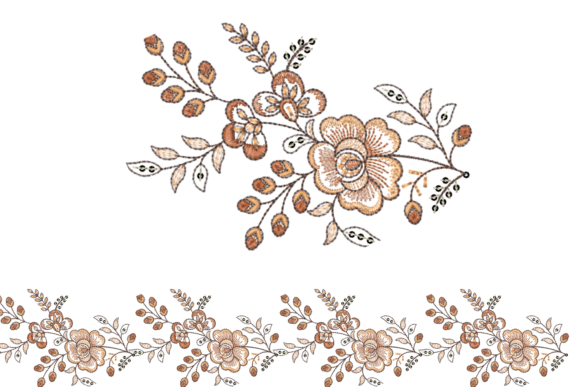
As an embroidery designer who’s developed hundreds of commercial designs for cafés, boutiques, bakeries, florists, and handmade studios, my first impression of Ottoman Runner Border Embroidery is immediate: it reads as elegant, classic, and quietly confident. The description — “a symmetrical arrangement of graceful, flowing scrolls and delicate heart-shapes” — signals refined craftsmanship, not trend-chasing. It doesn’t shout; it invites. That makes it ideal for small businesses that want to signal quality without sacrificing warmth or approachability.
Where This Machine Embroidery Design Shines in Real Business Use
Ottoman Runner Border Embroidery isn’t just decorative — it’s a versatile brand asset. In my work with local creatives and Etsy sellers, I’ve seen this kind of border design elevate merchandise far beyond kitchen towels and tea towels (its natural Kitchen category home). Here’s where it delivers measurable value:
- Embroidered patches: Perfect as a center chest accent on denim jackets or woven labels for handmade product packaging — its symmetry ensures clean alignment and visual balance at 2.5”–4” sizes.
- Apron embroidery: When placed along the hem or pocket border, it adds artisanal polish to café, bakery, or florist staff uniforms — reinforcing care and attention to detail.
- Cap embroidery: Works beautifully on the side or back of structured caps when scaled to 1.75”–2.25” width — the flowing scrolls soften the rigidity of headwear while maintaining legibility.
- Tote bag design: As a subtle runner along the top edge or base seam, it transforms a generic canvas tote into a branded, tactile experience — especially effective for boutique merch or farmers’ market giveaways.
- Custom apparel accents: On sleeve cuffs, collar bands, or pocket flaps of work shirts and smocks, it functions like quiet signature branding — recognizable but never overwhelming.
Use With Intention: Where Caution Applies
While Ottoman Runner Border Embroidery excels in many contexts, its ornamental nature means thoughtful placement matters. Avoid using it:
- At under 1.5” width on small patch sizes — delicate heart-shapes and fine scroll outlines may blur or lose definition;
- On highly curved surfaces like cap fronts without testing — symmetry can distort if digitized without curve compensation;
- Over dense textured fabric (e.g., heavy linen, burlap, or looped terry) without extra stabilizer — fine scrolls require smooth support to hold shape;
- On dark uniforms unless paired with high-contrast thread colors — pale ecru or gold metallics pop; off-white may recede;
- In applications requiring frequent washing (e.g., daily-use aprons) without confirming stitch density — intricate flourishes demand balanced density to prevent fraying over time.
How It Strengthens Brand Identity and Customer Trust
For small businesses, every embroidered detail contributes to perceived value. Ottoman Runner Border Embroidery communicates heritage, intention, and hand-crafted care — even when stitched by machine. When customers see this motif on a bakery’s linen napkin or a pet brand’s bandana, they subconsciously associate it with reliability and aesthetic consistency. Unlike trendy graphics that date quickly, this design supports long-term brand identity across seasons and product lines. It also increases buyer engagement: Etsy shoppers consistently report higher conversion on items with cohesive, elevated embroidery — especially when used across multiple touchpoints (tote + apron + packaging).
Practical Designer Notes Before You Stitch
Before committing to production — whether for your own small business merch or client work — run these checks:
- Test in black and white first: Print a grayscale mockup to assess contrast, spacing, and rhythm — no color distractions.
- Verify small-patch viability: Resize the digital embroidery file to your target patch dimensions and zoom in — do scrolls remain fluid? Do heart-shapes retain clarity?
- Review thread color contrast: Especially on dark or textured substrates — what looks elegant on screen may vanish on charcoal twill.
- Inspect spacing and underlay: Ornamental borders need precise stitch overlap control to avoid gaps or crowding — check the digitizing for consistent density.
- Confirm hoop size compatibility: Symmetrical runners often require larger hoops — ensure your machines (or vendor’s) support the full repeat width.
- Test on real fabric: Run a sample on your exact substrate — cotton duck, canvas, denim — with appropriate stabilizer (cutaway works best for fine scrolls).
- Create a printable mockup for client approval — include context (e.g., on a folded tote or apron pocket) so stakeholders visualize real-world impact.
- Compare beside other design assets: Does it harmonize with your logo, typography, and existing design assets? Consistency builds recognition.
- Confirm commercial licensing: Since you’re using Ottoman Runner Border Embroidery for commercial embroidery, verify usage rights cover resale, staff uniforms, and branded product labeling.
Final Thought: More Than a Kitchen Embroidery File
This isn’t just another machine embroidery design for dish towels. Ottoman Runner Border Embroidery is a flexible, timeless element that helps small businesses say, “We pay attention — to craft, to detail, to how things feel in someone’s hands.” Whether stitched on a florist’s canvas wrap, a ceramicist’s studio apron, or a pet brand’s bandana, it quietly reinforces professionalism and care. For embroidery shops and designers, it’s a reliable, licensable asset that scales across mediums — from cap embroidery to tote bag design — without losing its soul. Just remember: elegance lives in execution. Test, refine, and let the scrolls flow — thoughtfully.