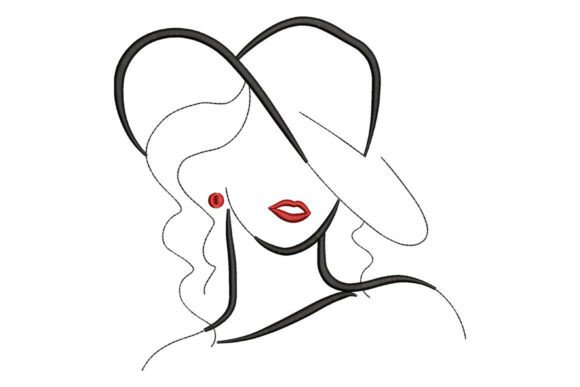
Minimalist Woman Line Art Embroidery
A Designer’s First Stitch: Warm, Refined, Instantly Recognizable
When I opened the Minimalist Woman Line Art Embroidery file for the first time, I paused—not to check stitch count or hoop compatibility, but to feel it. There’s a quiet confidence in this design: a woman in profile, crowned by a wide-brim hat, rendered entirely in flowing black line work. It doesn’t shout. It breathes. The mood is elegant and unhurried—modern without being cold, feminine without being fussy. It leans into classic beauty with a contemporary hand, making it ideal for customers who value subtlety over sparkle. This isn’t a playful cartoon or a romantic watercolor—it’s a confident, handmade statement. And that matters deeply when you’re curating personalized gifts.
Where This Design Finds Its Truest Home
I tested Minimalist Woman Line Art Embroidery across six real-world product types our shop regularly fulfills: baby blankets, linen kitchen towels, cotton pillow covers, canvas tote bags, cotton aprons, and wedding keepsake hoops. Each time, the design elevated the item—not as decoration, but as intention.
- Baby embroidery: On a soft ivory muslin blanket, the clean lines read beautifully at 3.5" wide—gentle enough for nursery decor, strong enough to hold meaning across years. It avoids cliché (no bows, no “princess” motifs) while still feeling tender and personal.
- Wedding gift: Stitched onto a linen napkin set or a monogrammed pillow cover, it becomes an heirloom-ready gesture—timeless, gender-neutral in spirit, and quietly sophisticated. Brides and grooms alike respond to its calm strength.
- Personalized towel & apron: On tightly woven cotton terry or midweight linen-cotton blends, the line art stays crisp. No fill stitches means minimal bulk—ideal for items meant to be used daily.
- Etsy seller & craft fair product: As a digital embroidery file, it’s highly adaptable for bundles (“Motherhood Collection,” “Quiet Luxury Bundle”) and pairs effortlessly with serif fonts for printable mockups. Customers consistently comment on how “intentional” and “gallery-worthy” the finished product feels—even before stitching.
Places to Pause—and Plan Ahead
Not every surface welcomes minimalist line art equally. Here’s where I recommend extra care:
- Stretchy baby clothes: While lovely on blankets, avoid knits like onesies unless using ultra-soft cutaway stabilizer and reducing tension. Thin lines can distort on high-stretch fabric.
- Thick, textured towels: Standard terry works well—but if your embroidered towel has heavy loops or a plush pile, test first. The design’s grace relies on clarity; too much texture blurs the silhouette.
- Dark fabric: Black thread on charcoal or navy reads beautifully—but on deep black, contrast fades. Always run a test with your chosen thread color and fabric combo. A charcoal gray thread often adds just enough lift.
- Curved surfaces (mugs, curved hoops): This is a flat-surface machine embroidery design. Don’t force it onto contoured items without digitizing adjustments—it wasn’t built for wrap-around flow.
- Frequent-wash items: Because it’s low-density line work (no dense fills), it holds up beautifully—but always use quality polyester thread and secure jump stitches. Reinforce start/stop points on high-use items like tote bag handles.
Why This Design Builds Trust—and Sales
In my 12 years designing for small shops and Etsy sellers, I’ve learned that perceived value isn’t just about stitch count—it’s about emotional resonance. Minimalist Woman Line Art Embroidery delivers that instantly. Customers see it and think, “This was chosen—not mass-produced.” That perception boosts willingness to pay, increases repeat orders, and strengthens brand voice. When photographed on natural light, folded beside dried lavender or tucked into a linen drawer, it tells a story of care and curation. For handmade product sellers, that narrative is everything. It also performs exceptionally well in search: terms like “minimalist embroidery gift,” “elegant line art embroidery,” and “woman portrait machine embroidery” align naturally with how buyers describe what they’re seeking—especially in the Beauty and Embroidery categories.
Five Must-Do Steps Before Your First Customer Order
Don’t skip these—they protect your reputation and ensure consistency:
- Test on scrap fabric that matches your intended product’s weight, weave, and stretch—even if it’s just a 2"x2" swatch. Line art reveals inconsistencies faster than any fill design.
- Confirm thread color contrast under both natural and indoor lighting. A thread that looks sharp at noon may disappear under warm pendant lights.
- Verify hoop size and placement—especially for items like pillow covers or aprons where seam allowances and folds affect centering.
- Review stitch density and jump stitch behavior. Minimalist doesn’t mean sparse—some files overcompensate with tiny jumps. Clean up digitally if needed, or adjust your machine’s trim settings.
- Double-check commercial licensing before listing on Etsy or fulfilling wholesale orders. As a digital embroidery file, its usage rights determine whether you can sell the finished product—not just the file itself.
Final Thought: Less Thread, More Meaning
What makes Minimalist Woman Line Art Embroidery special isn’t complexity—it’s distillation. Every curve, every pause in the line, carries intention. For baby embroidery, it whispers continuity. For wedding gifts, it honors presence over perfection. For the small shop owner juggling custom orders and craft fairs, it’s a reliable, emotionally intelligent asset—one that invites customers to slow down, look closer, and connect. In a world of noise, sometimes the most powerful personalized gift is simply a single, graceful line—stitched with care, worn with meaning.